
Journey Towards Cosmic Dawn
Since its launch in 2023, the Euclid space telescope has been sending images of the night sky back to a large consortium of scientists from countries around the world, who combine it with data from various telescopes on Earth. The Euclid space mission is an imaging survey of an extremely large swath of the night sky, with the goals of creating a map of the large-scale structure of the universe in 3D, as well as exploring the nature and evolution of dark energy. But space telescopes like Euclid rarely work alone — their observations are almost always done in partnership with ground-based telescopes, like those here in Hawaiʻi on Maunakea and Haleakalā.
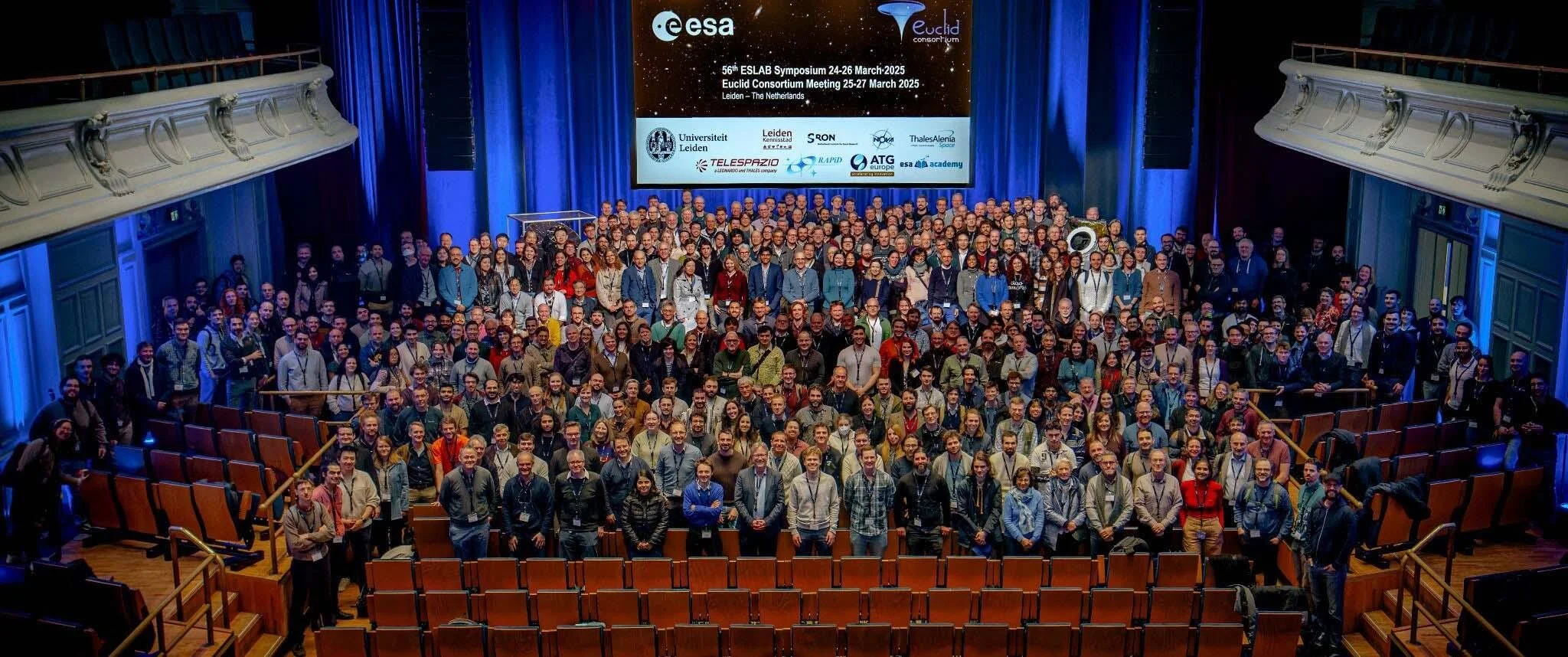
The Euclid consortium together in Leiden, Netherlands, in March 2025. (Image credit: Naor Scheinowitz)
Hand-in-Hand: Hawaiʻi Telescopes and Euclid
Four Hawaiʻi-based telescopes, including the W.M. Keck Observatory, Subaru Telescope, and Canada-France-Hawaiʻi Telescope on Maunakea and the University of Hawaiʻi Institute for Astronomy’s Pan-STARRS Telescopes on Haleakalā, are working in collaboration with Euclid to search for the earliest objects in the universe and form a richer picture of the deep sky.
The ground-based telescopes complement, enhance, or further explore Euclid’s data, adding wavelengths, colors, and detail that the space telescope is not equipped to do alone. “It's very common for a space telescope to discover something interesting in the sky but not have the capability or size to characterize it more thoroughly,” explained John O’Meara, Chief Scientist & Deputy Director at W. M. Keck Observatory. The Euclid Mission is unique in that it was designed to collaborate with ground-based telescopes from the start, whose contributions are “absolutely essential” to creating the scientific discoveries of Euclid.
A Look Back to the Universe’s Infancy
The newest exciting discovery from a Euclid-Maunakea Observatories collaboration is the confirmation of a huge batch of ancient quasars, including the two most distant quasars ever found. After Euclid detected 31 possible quasars from its wide sky survey, Subaru Telescope contributed further imaging data of the quasars, while W.M. Keck Observatory confirmed them as genuine and constrained their very ancient age — back to the first 670 million years of the universe’s life, or 5% of its current age.
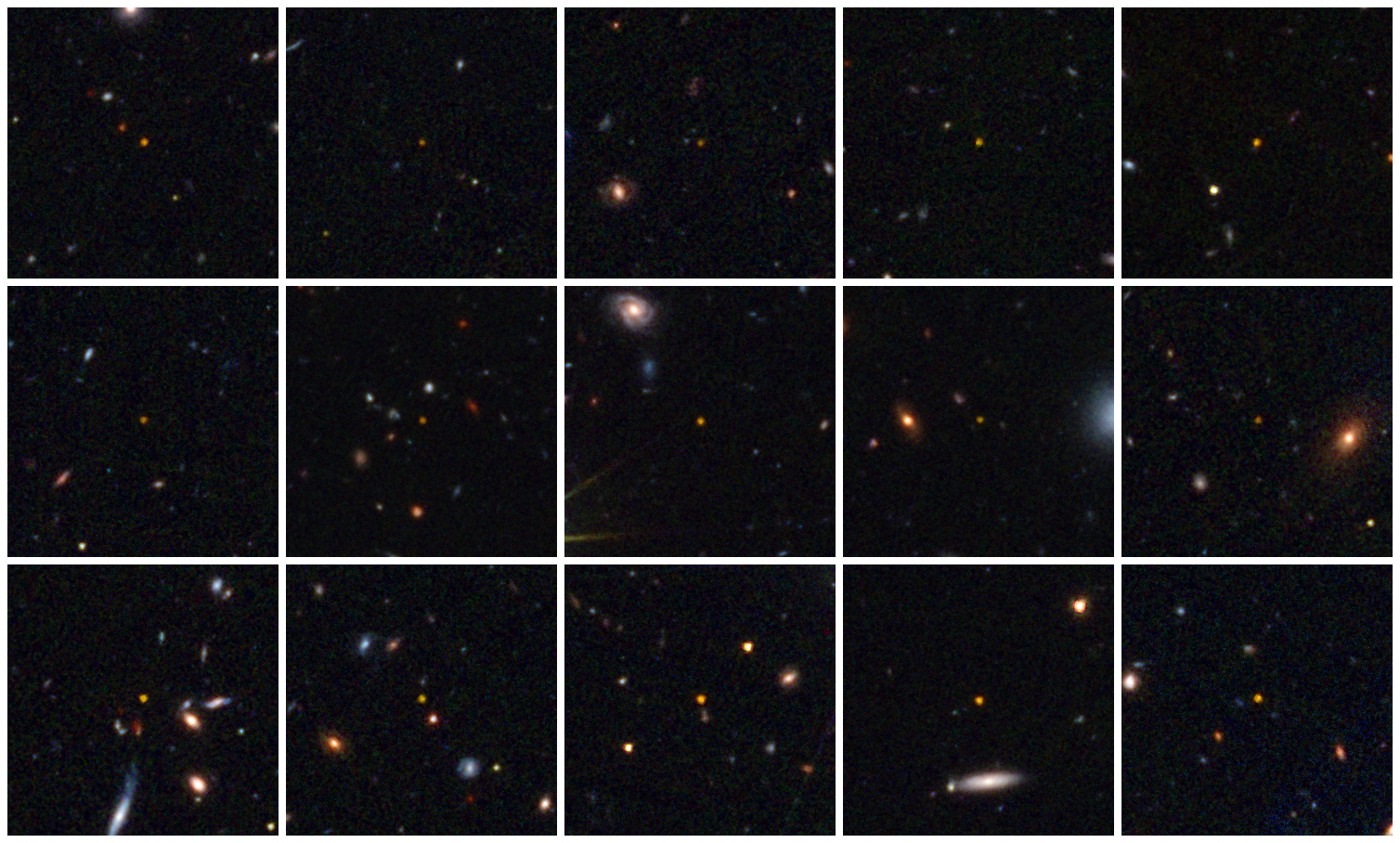
Some of the newly discovered quasars, the red-orange small dots at the center of each image. (Image credit: European Space Agency)
A quasar is a super-bright object at the center of a galaxy that outshines the rest of its galaxy by a long shot. They allow scientists to see galaxies that they wouldn’t be able to see otherwise, as that central super-bright light serves as a beacon for an early galaxy that would normally be too dim to spot.
Quasars form during a particularly active period of time in a galaxy’s life, which is short-lived but extremely influential. Their extremely bright light is thanks to the fact that they formed while the black hole at the galaxy’s center was eating up huge amounts of material, which makes an extremely hot and bright “accretion disc” that can be seen from immense distances. It is believed that in turn, the quasar’s powerful radiation blows enough material out of the galaxy to shut off the formation of new stars in the galaxy. These ancient quasars indicate not only very early, distant galaxies but also a particularly interesting period in a galaxy’s life that strongly influences its evolution.
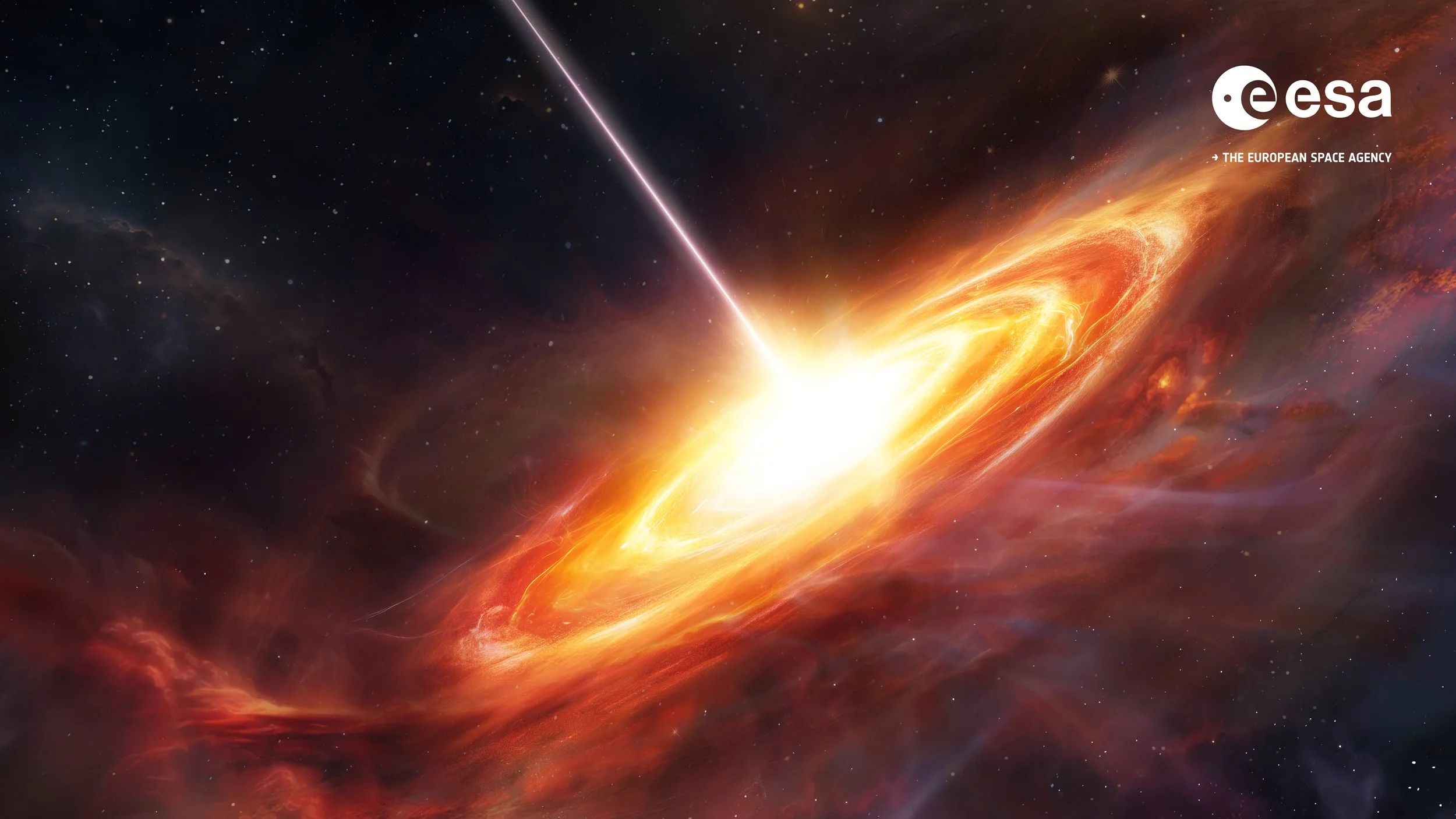
Artist’s concept of an ancient quasar. (Image credit: European Space Agency)
Scientists have been hunting for the earliest quasars for decades in a quest to better understand a period of the early universe that is highly debated in astronomy. This period, known as “cosmic dawn” or the “age of reionization,” is when astronomers think the first galaxies and supermassive black holes began to form. But quasars from this early stage are very rare and difficult to find. “We’re now looking at a time in the universe’s history where some models say quasars should exist, and some say they shouldn’t,” because it predates some estimations of when we think the first galaxies formed, John explained.
Finding just one or two ancient quasars isn’t quite enough to understand them as a general population. John explained that "it would be like spotting one 100-year-old person on the street. Seeing them would tell you that it’s possible for humans to live to a hundred, but it doesn’t tell you anything about the source of their longevity.” If we really want to understand the still-unknown sources of energy that heavily influenced the formation and evolution of galaxies in the universe, we need to measure quasars as a group.
The most distant quasars have a recognizable signature. They register as very bright in the near-infrared Euclid images but are very dark or faint in optical images. “Euclid detects numerous near-IR sources, but without the optical imaging [provided by Hawaiʻi telescopes], we would have no way of identifying which of these sources are dark or faint in the optical — and therefore which ones are likely to be distant quasars. Without this, it would be like trying to recognize the color red in an RGB image without the blue channel,” explained Yoshiki Matsuoka, an associate professor at Ehime University in Japan and a member of the Subaru Telescope team who provided optical imaging for Euclid.
The international distant quasar team brought together by Euclid shared a single, very simple goal: to find the most distant quasars in the universe. Scientists who might previously have been competitors in this field found themselves on the same team, which for Yoshiki is one of the most enjoyable parts of the experience. “The differences in our expertise and ways of thinking were a source of strength, and they were brought together into a powerful project through close communication and discussion,” said Yoshiki. “I was amazed to see the passion of so many people who were working together to make a single mission a success.”
“I am very honored to be part of the team that now holds the record [of ancient quasars discovered]. At the same time, I know this is just the beginning of the story,” said Yoshiki. Euclid has surveyed only a small fraction of its planned sky coverage so far and will remain operational for the rest of the decade, giving scientists plenty of time to continue quasar-hunting.
Hawaiʻi Telescopes Band Together
It was clear from the earliest rumblings of the Euclid mission that it would require a huge team effort to complete its lofty goal of creating a 3D map of the universe while taking into account the presence of dark energy. The third dimension is the distance between various galaxies. A coalition of Hawaiʻi-based telescopes joined forces to add the color that allows scientists to estimate those distances. While collaborations between various ground-based telescopes tend to be simpler and easier to coordinate, collaborations involving both ground-based telescopes and space missions tend to be bigger, more complex, and involve people with more diverse backgrounds, said Yoshiki.
Euclid’s ambitious imaging objectives require a huge amount of telescope time, so large that no single telescope can do it alone. “When the mission was selected, we knew we would need the ground-based data, but we originally didn’t know who would fill the niche,” explained Jean-Gabriel Cuby, Executive Director of Canada-France-Hawaiʻi Telescope (CFHT). It became clear that based on Euclid’s target region, they would need considerable time on powerful telescopes in the Northern Hemisphere. Canada-France-Hawaiʻi Telescope, Subaru Telescope, and Pan-STARRS were the best suited to contribute, in no small part due to the unparalleled observing conditions in Hawaiʻi.
These telescopes banded together to create the Ultraviolet Near Infrared Optical Northern Survey (UNIONS), a similarly ambitious imaging survey of the northern sky in the optical and near-infrared that began in 2017. The UNIONS collaboration was designed to harness the strengths of all three telescopes in imaging different colors, with each facility providing a monochrome image of the same area in different color bands, creating a full-color picture of the region. By combining these different color bands, astronomers can estimate the distances between objects with much greater accuracy. Quantifying the distances between objects like galaxies and quasars is crucial for Euclid to create a 3D map of the sky.
Even telescopes like Euclid that are equipped with a limited set of filters cannot achieve the complexity of colors required to get a good estimate of the distance of an object. “We need as many colors as possible. This is absolutely essential for the scientific objectives of Euclid, and it cannot do it alone,” said Jean-Gabriel.
CFHT’s MegaCam excels in the blue and ultraviolet range, or band, of the color spectrum, which is important for estimating the distance of an object. Every image a telescope takes is always through a filter, which limits the wavelength range, or color, in the final image. MegaCam is mounted at CFHT about half of the time, which allows for more observing opportunities than many other telescopes can provide. Pan-STARRS’s years of asteroid observation have provided a wealth of red data. The Subaru Hyper-Suprime Cam, a gigantic camera mounted in the best position, or prime focus, provides the far-red color band. “While at its basic function — taking images of the sky at optical wavelengths — it is a relatively simple instrument; its field of view is far larger than that of any other instruments on a large telescope like Subaru,” explained Yoshiki. This massive field of view, and therefore the exceptional speed at which it can survey the sky, was crucial for the job. Only with each UNIONS telescope contributing to a section of the color spectrum are we able to see the full detail of Euclid’s images of the night sky. This generates the dazzling technicolor images coming out of Euclid, as well as the critical information needed to constrain the distance of objects like quasars.
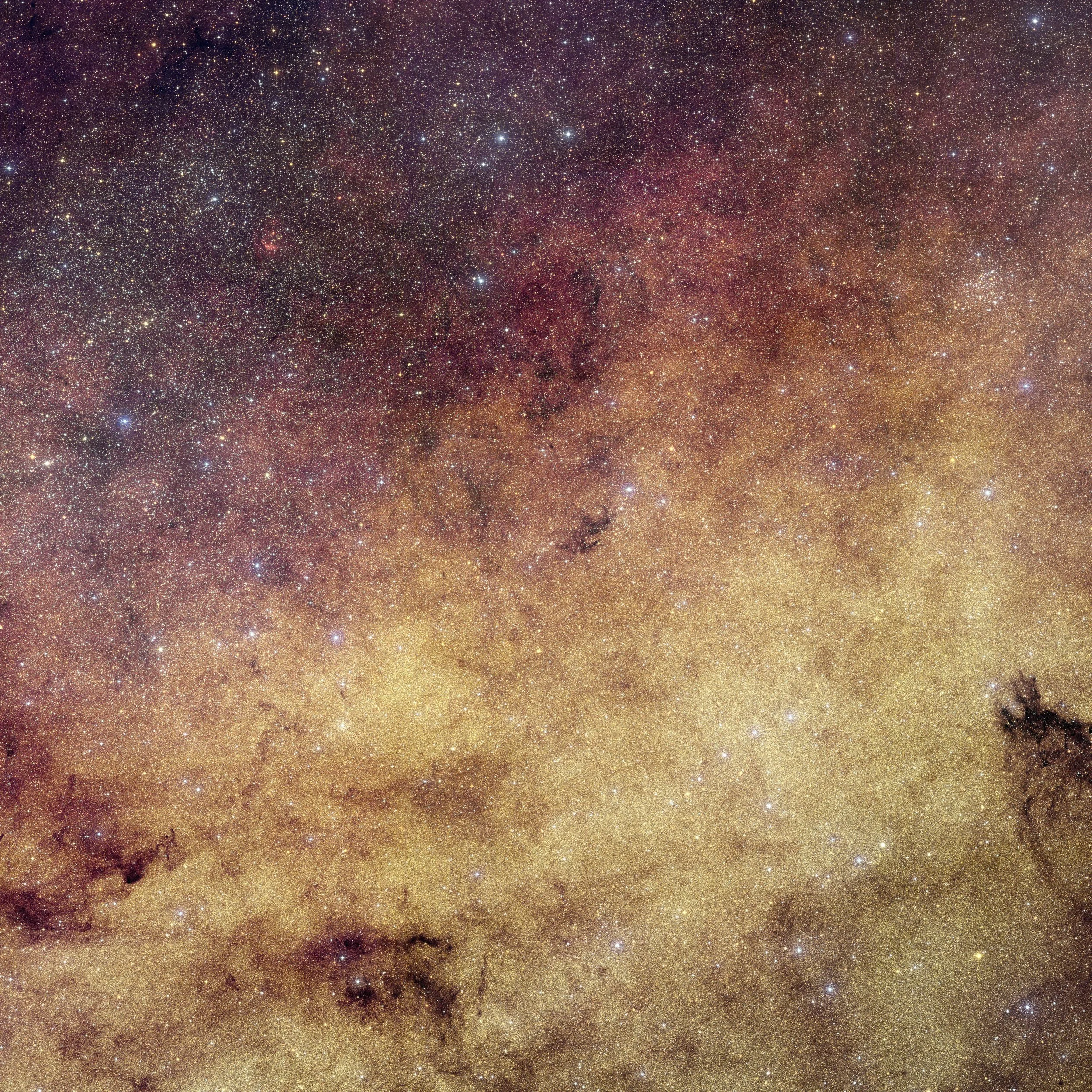
The largest high-resolution photo ever made of our Milky Way galaxy's center in visible light. Original image taken by Euclid, color added by CFHT MegaCam. (Image credit: ESA/Euclid/Euclid Consortium/NASA, CFHT, image processing by J.-C. Cuillandre and E. Bertin (CEA Paris-Saclay))
More Quasars and Amazing Images to Come
For these scientists at Hawaiʻi telescopes working with the Euclid mission, the opportunity to be part of this internationally united collaboration is unlike any other. “It was an exciting new experience that I have never encountered in my career,” said Yoshiki. These space-based and ground-based collaborations are large enough in size and funding to essentially draft their “dream team” of telescopes, bringing together powerhouses like our Hawaiʻi telescope teams to accomplish some of the most ambitious projects in astronomy. On quasars, Yoshiki said, “I'm confident that the record will soon be broken again by our own team, and I look forward to continuing this journey toward the Big Bang, against the flow of time.” Stay tuned, because we can expect to see more groundbreaking discoveries come out of the collaborations with Euclid in the coming years.
